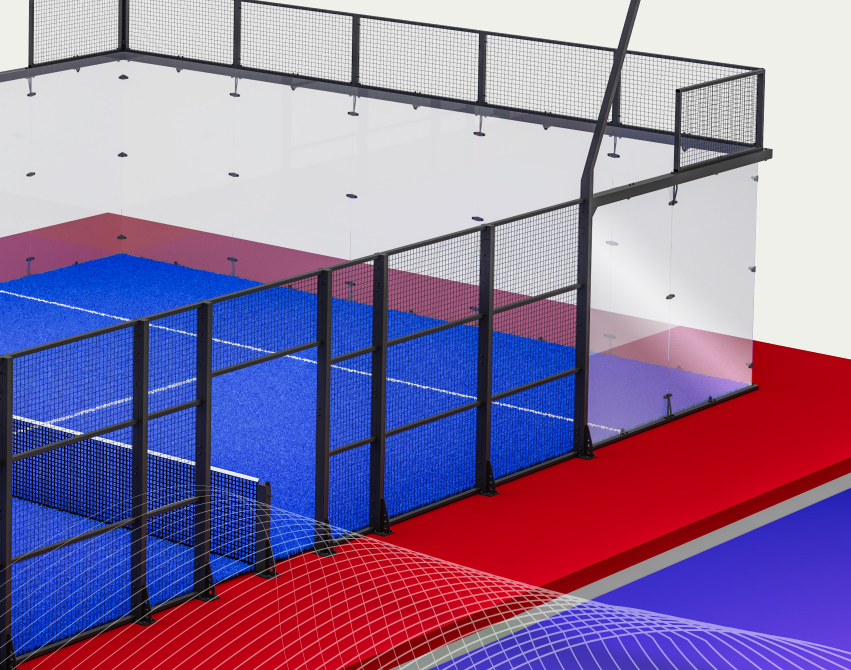
Before anything else, a padel project comes down to two numbers: the size of the court and the space around it. This article collects the official dimensions in one table and explains what “FIP-compliant” actually means; because the phrase covers three different things that are often confused.
What are the official padel court dimensions?
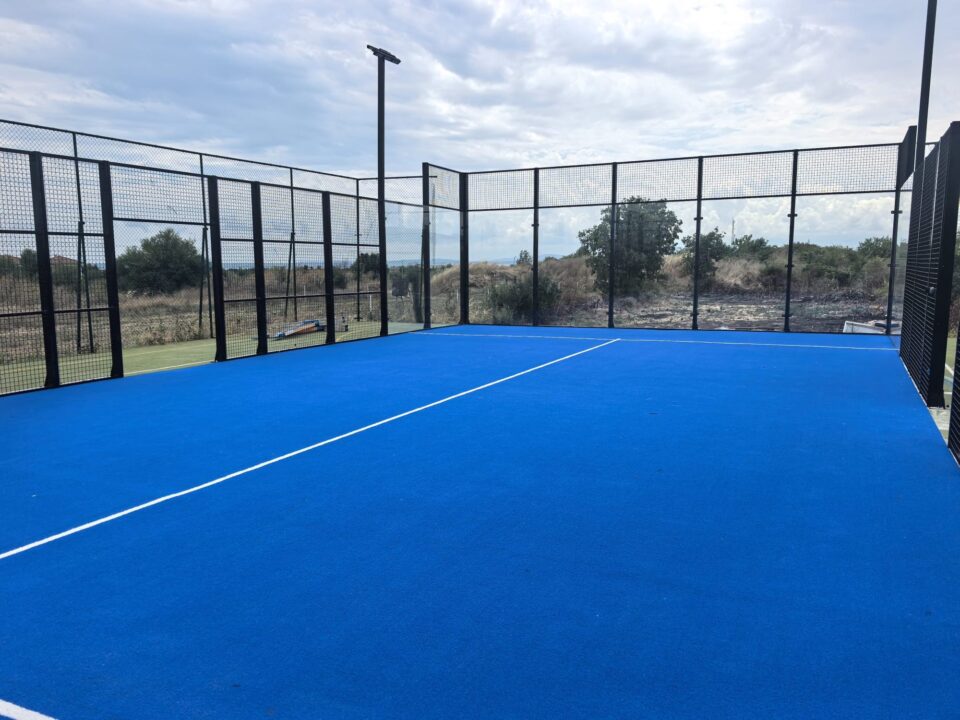
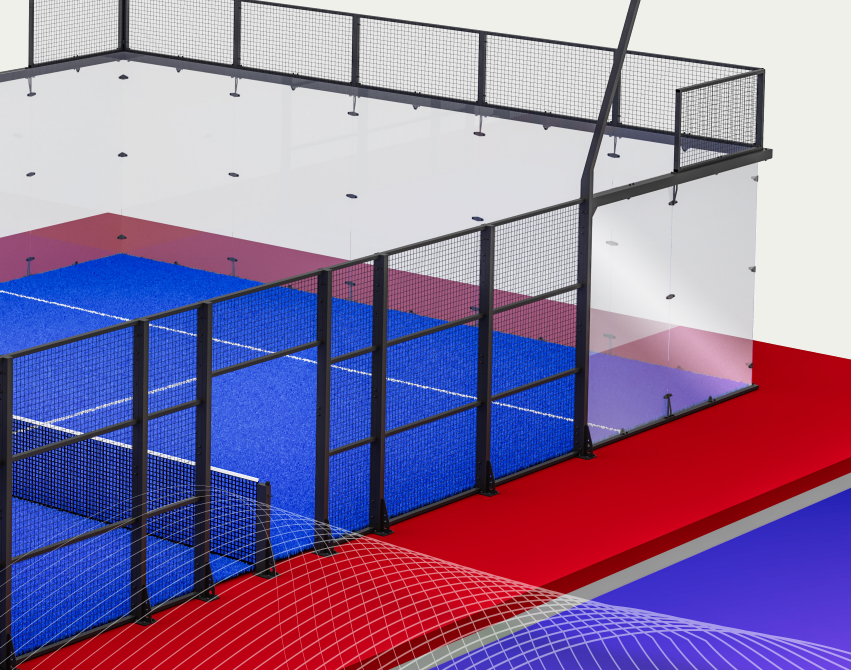
A standard padel court is 20 metres long and 10 metres wide, fully enclosed. The net is 88 cm high at the centre and 92 cm at the posts, which sit 0.5 m outside the side lines. The back walls are 4 metres high: 3 metres of tempered glass with 1 metre of metallic mesh above. The side walls are stepped: 4 metres at the back corner, dropping to 3 metres towards the net.
| Element | Dimension |
|---|---|
| Playing area | 20 × 10 m, enclosed |
| Net height | 88 cm centre · 92 cm at posts |
| Net posts | 0.5 m outside the side line |
| Back wall | 4 m total: 3 m tempered glass + 1 m mesh |
| Side wall | 4 m at the back, stepping down to 3 m |
| Mesh aperture | Maximum 6.25 × 6.25 cm |
| Indoor free height | Minimum 6 m; 8 m recommended for new facilities |
Is 20 × 10 metres enough space?
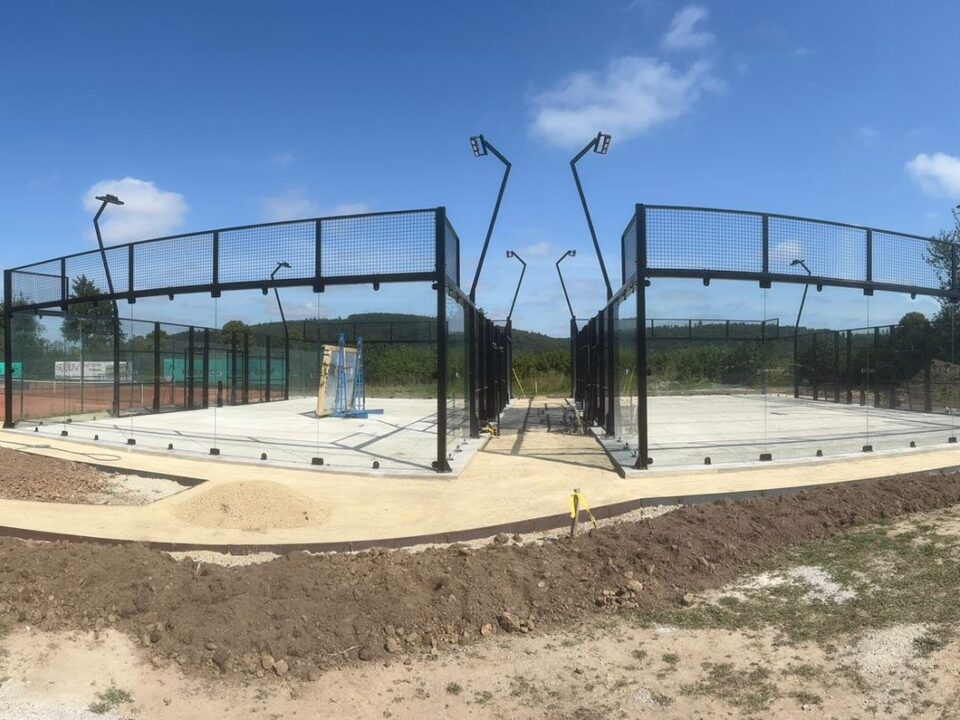
No; that is the court itself, not the site. Clearance is needed around the court for installation, maintenance and safe circulation, plus the door position, lighting poles and any spectator area. In practice we recommend a level area of at least 12 × 22 metres for a single court. For multiple courts, the spacing between them is added; it is required both for player safety and for future maintenance access.
What does “FIP-compliant” really mean?
It refers to three separate layers that are frequently mixed up. First, dimensional compliance: the court is built to the FIP dimensions. Second, product certification: the glass is tempered to EN 12150 with a CE declaration of conformity, galvanised sheet follows TS EN 10346. Third, production certification: the steel structure is manufactured under EN 1090 and welded fabrication follows EN ISO 3834-2. When a supplier says “certified”, ask which of the three they mean; they are not the same thing.
Do tournament and club courts differ in size?
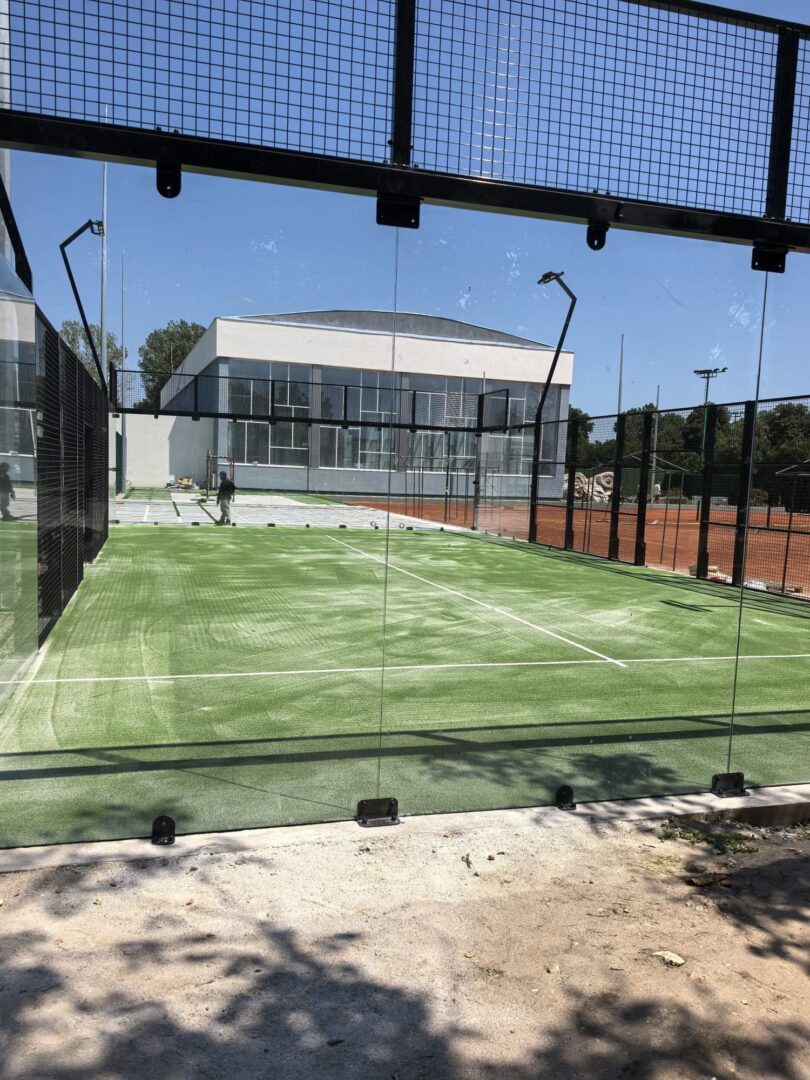
The playing area is identical: 20 × 10 m everywhere. What differs is everything around it: free height indoors, lighting level and uniformity, spectator space, camera positions and the playing characteristics of the surface. If you plan to host tournaments, the decision is driven by these surrounding conditions rather than by court size. We cover indoor requirements here.
Why do tolerances matter?
Because errors start in the slab, not in the assembly. If the level and flatness of the platform fall outside tolerance, the structure is forced, stress accumulates at the glass fixings and the court “settles” over time. This is why the manufacturer issues the slab specification and the platform is checked before installation begins. What determines the life of a court is often not the thickness of the glass but the flatness of the concrete.
Send us the dimensions of your area and we will prepare the layout.