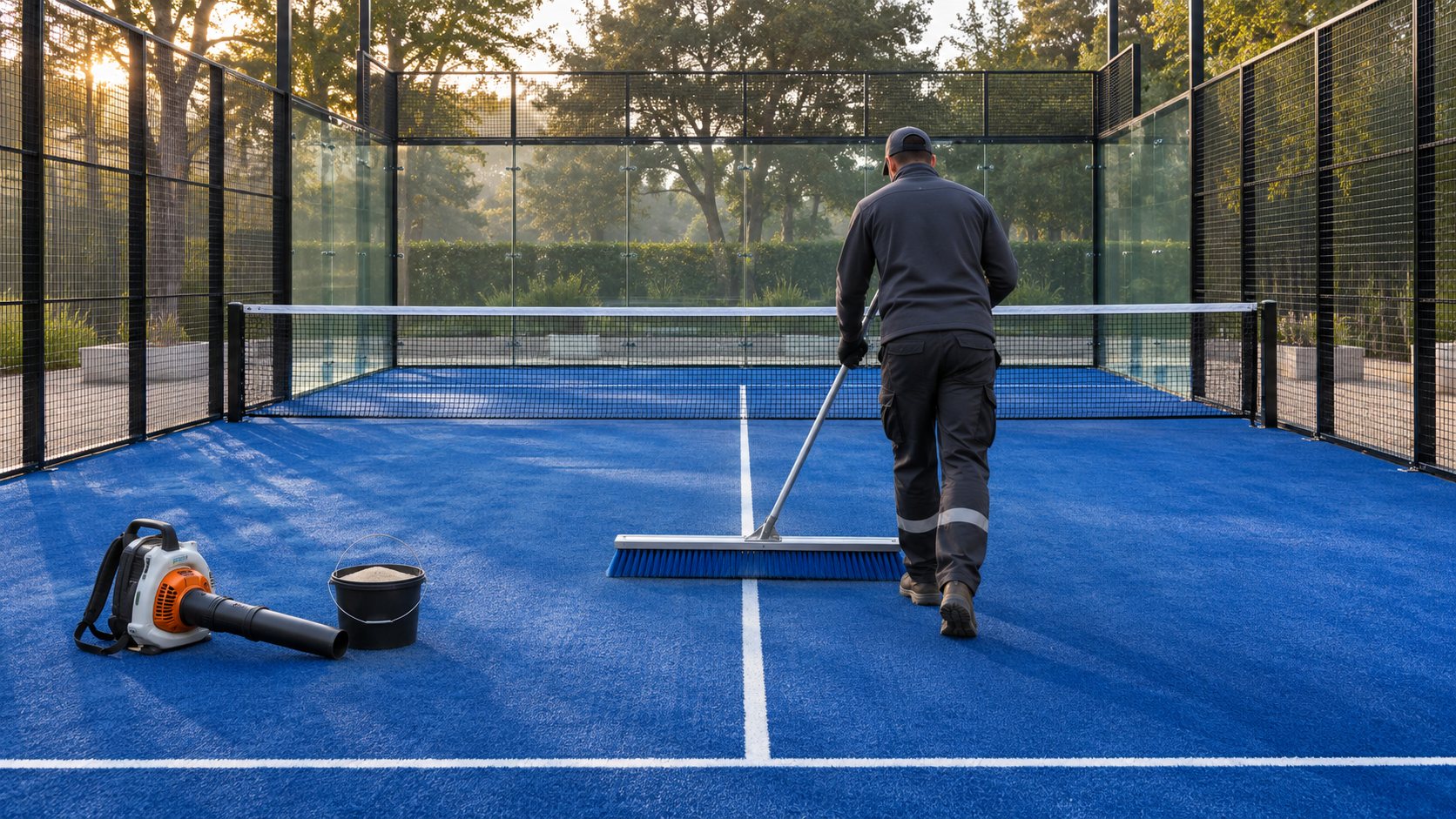
Maintenance on a padel court is not a job you do when something breaks; it is a routine tied to a calendar. A court that is maintained keeps its playing character for years, while a neglected one returns the neglect first as player complaints and then as cost. Below is a schedule from weekly to annual, with the reason behind each task.
What does a padel court maintenance schedule look like?
| Frequency | Task | Why |
|---|---|---|
| Weekly | Sweep the surface, clear leaves and litter; clean glass | Organic debris holds moisture and flattens fibres |
| Weekly | Visual check of infill distribution | Build-up and bare patches are caught early |
| Monthly | Brush to redistribute the infill | Fibres stay upright, playing speed stays constant |
| Monthly | Net tension and fixings | A slack net changes play and dimensions |
| Quarterly | Torque check on bolts and fixings | Vibration and thermal movement loosen connections |
| Quarterly | Clean and check luminaires | Dust quietly reduces light levels |
| Six-monthly | Top up infill if needed; deep brushing | Replaces lost infill |
| Six-monthly | Check drainage and water discharge | Standing water damages surface and structure |
| Annually | Structure and coating inspection, corrosion check | Early action is cheaper than panel replacement |
| Annually | Glass panels, gaskets and fixings | Stress build-up is seen before breakage |
What is the most common mistake?
Only topping up sand when it runs low. What matters as much as the quantity is the distribution. During play the infill migrates from the service area and baseline towards the edges; even when the total stays the same, one part of the court hardens while another becomes slippery. Regular brushing redistributes it and removes that difference. Topping up is only needed where brushing no longer restores the level. The relationship between turf and infill is covered here.
What to watch on the glass panels
Tempered glass resists impact well but is sensitive to stress at edges and fixing points. In routine checks look for loosening fixings, worn gaskets and spacers, and chips or scratches at the panel edges. An edge chip should not be left; stress propagates from that point over time. Abrasive products and metal scrapers must not be used for cleaning.
Why keep a maintenance record?
For three reasons: it evidences the work done if a warranty claim arises, it shows the court’s history when a facility changes hands, and (most usefully) it exposes recurring problems. If infill keeps disappearing from the same area, the issue is the fall rather than the sand; if the same fixing keeps loosening, there is a load problem there. Even a simple table makes these patterns visible.