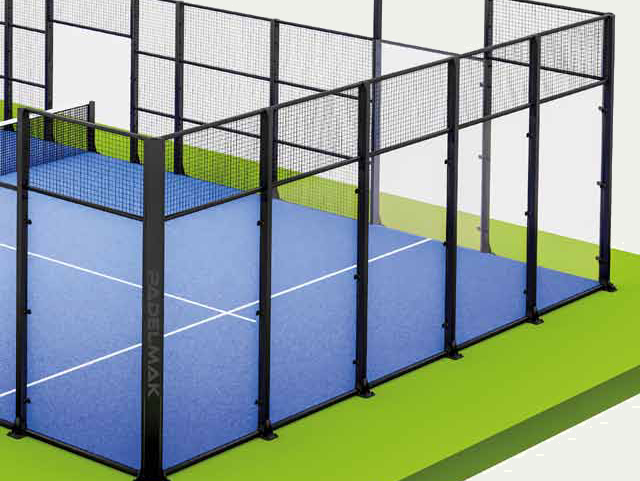
The surface is the first thing a player notices: how the ball bounces, how the foot slides, how much load the knee takes. It is also the item a facility operator replaces most often. This article explains the difference between monofilament and fibrillated turf, what dtex and stitch density actually mean, and why the infill sand counts for half the surface.
Monofilament or fibrillated turf?
Monofilament turf is produced as individual fibres; it stands upright, the ball bounce is predictable and the appearance lasts. Fibrillated turf is made from a wide tape cut and opened into a net; the fibres interlock, hold the infill sand well and cost less initially. Monofilament is the common choice for padel because bounce and sliding behaviour stay more consistent; on heavily used courts fibrillated turf tends to lie flat over time and the playing character changes.
| Monofilament | Fibrillated | |
|---|---|---|
| Fibre structure | Individual filaments | Cut and opened tape (net) |
| Ball bounce | Predictable, consistent | Can change over time |
| Infill retention | Even distribution | Locks sand more firmly |
| Under heavy use | Stays upright | Tends to lie flat |
| Initial cost | Higher | Lower |
What do dtex and stitch density mean?
Dtex is the weight in grams of 10,000 metres of fibre; broadly, how thick the fibre is and therefore how well it resists wear. Stitch density (stitches per square metre) describes how dense the turf is. The two must be read together: high dtex with sparse stitching gives a thick but gappy surface, while low dtex with dense stitching looks full at first and wears quickly. When comparing quotations, ask for both figures; with only one, you are seeing half the picture.
Why does the infill sand matter so much?
The sand is spread between the fibres to keep them upright, stabilise the base and set the speed of play. Too little sand lets the fibres lie down and the surface harden; too much kills the ball and increases sliding. Grain size and roundness matter as much as quantity; angular grains cut the fibres. Distribution shifts through the season, so regular brushing, with top-ups where needed, extends the life of the surface directly.
When should the surface be replaced?
Use decides this, not the calendar. The signs are: fibres permanently flattened, seams opening, areas that stay hard despite added sand, and visible wear around the service and baseline areas. It is often possible to replace only the worn zone rather than the whole court; acting early is significantly cheaper than a full replacement.
Tell us how intensively your court is used and we will recommend the right surface.