In a padel investment the decisive number is not the cost of the court but how many hours a week it is sold. The same investment can pay back in eight years at 30% occupancy and in less than half that at 60%. This article sets out the variables and how to build your own model; we give you the formula rather than figures, because pricing varies from city to city.
How is court revenue calculated?
The basic formula is simple: sellable hours × occupancy rate × hourly price. Sellable hours are the hours the court can actually be rented; for an outdoor court that is limited by weather and daylight. Occupancy shows how many of those hours are sold. The third variable, price, depends on location, facility quality and competition. The most common mistake is to estimate two of the three optimistically and only one realistically.
Why do sellable hours matter more than the court?
A court may have a theoretical capacity of 14–16 hours a day, but demand is not spread evenly. Weekday evenings and weekend daytime are prime time, and they set the occupancy rate. Mornings and midday stay empty unless filled with schools, corporate bookings, coaching and tournaments. Building your model on a single average occupancy figure hides this; a table split by time band gives a far more realistic result.
| Time band | Demand source | What raises occupancy |
|---|---|---|
| Weekday morning | Retired players, flexible workers, coaching | Morning packages, lesson programme |
| Weekday midday | Corporate, schools | Company agreements, school partnerships |
| Weekday evening | Prime time, the core revenue | Memberships, fixed slots, leagues |
| Weekend | Families, friend groups, tournaments | Tournament calendar, coached sessions |
How much does a covered court change the numbers?
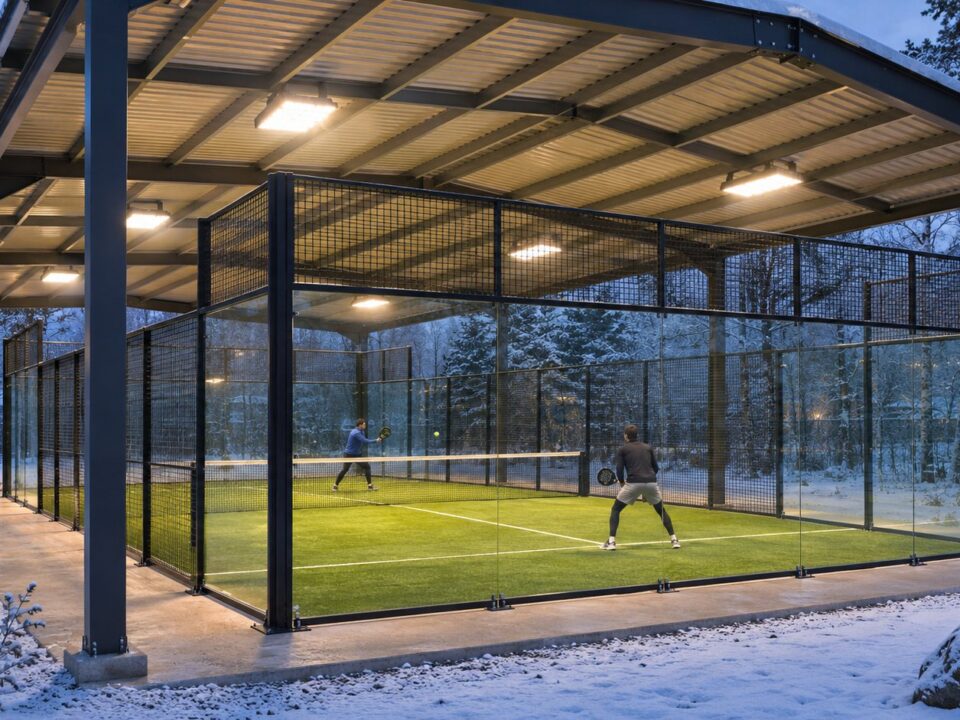
What a roof buys you is sellable hours. On an open court, rainy days, extreme midday heat and winter evenings drop out of the calendar, and the annual total is rarely trivial. A court roof recovers most of that without demolishing the court, usually at a far lower investment than a full indoor building. If your occupancy is already high, extending the usable hours of the existing court often pays back faster than adding another one.
What are the operating costs?
- Rent or land cost, usually the largest fixed item
- Energy: lighting, and climate control in an indoor facility
- Staff: reception, coaching, cleaning
- Maintenance: infill sand, brushing, glass and structure checks, schedule here
- Booking system, marketing and tournament costs
Their sum gives your monthly fixed cost; the break-even point is that figure divided by the contribution per court. Share your site plan and we will work through court numbers and layout with you.